


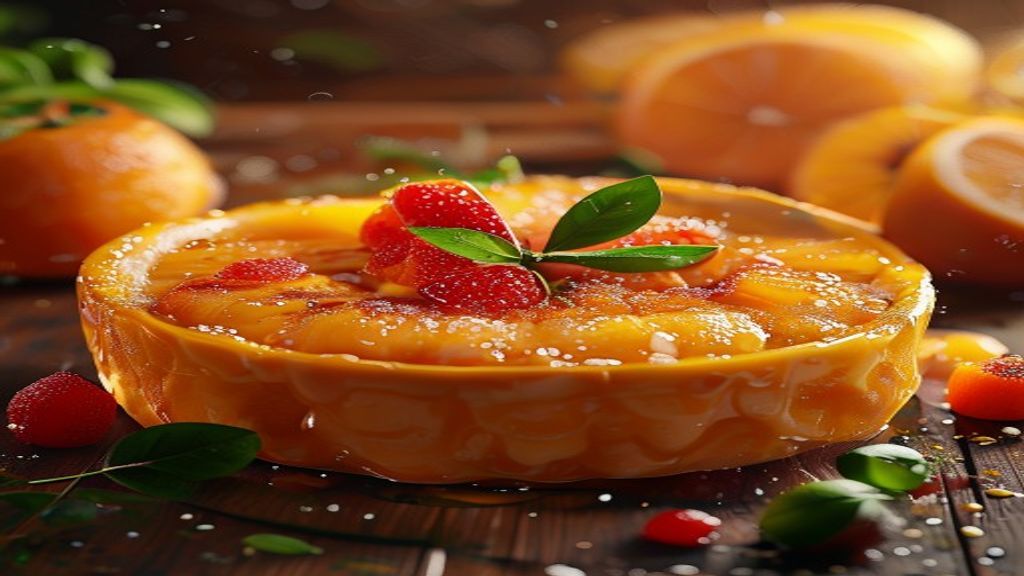
Prepare a delicious and creamy Tia Lene’s Orange Pudding in just a few minutes. This recipe evokes the delightful nostalgia of family Sunday lunches, bringing the perfect harmony between the sweetness of condensed milk and the fresh citrus of orange. With an incredibly silky texture and a glistening syrup with a hint of the fruit’s own juice, this pudding proves that simplicity, when executed well, transforms into haute cuisine. Get ready to receive compliments from everyone!
Tia Lene’s Orange Pudding: An irresistible dessert that elevates the classic milk pudding to a new level of sophistication and freshness, using simple ingredients you surely have at home.
Summary
Ingredients
For the Orange Syrup:
- 1 cup (tea) refined sugar
- 1/2 cup (tea) natural, strained orange juice (preferably Valencia orange)
For the Pudding:
- 1 can condensed milk (395g)
- 1 cup (tea) natural, strained, concentrated orange juice
- 4 large whole eggs
- 1/2 cup (tea) whole milk
- 1 tablespoon orange zest (only the orange part, without the white pith)
- 1 teaspoon cornstarch (optional, to ensure an even firmer texture)
Instructions
- Prepare the Syrup: In a wide-bottomed saucepan, place the sugar and heat over low heat, letting it melt slowly until it becomes a light golden caramel. Carefully add the orange juice (it may splatter). Stir gently until the sugar lumps dissolve completely and the syrup thickens slightly, acquiring a syrupy consistency. Pour this syrup into a pudding mold (with a 20 cm diameter central hole), spreading it up the sides. Set aside.
- Blend the Ingredients: In a blender, add the eggs, condensed milk, orange juice, whole milk, and cornstarch. Blend on medium speed for about 2 to 3 minutes until smooth.
- Add the Aromatic Touch: Turn off the blender, add the orange zest, and gently mix with a spatula, without blending, to preserve the essential oils and avoid excessive air bubbles.
- Rest the Batter: Let the mixture rest in the blender jug for about 10 minutes. This will cause the foam to rise to the surface. With a spoon, remove and discard this foam to achieve an ultra-smooth pudding.
- Bake in a Water Bath: Slowly pour the pudding batter into the caramelized mold. Cover the mold tightly with aluminum foil (shiny side facing inward). Place the mold inside a larger baking pan filled with hot water and a tablespoon of vinegar (to prevent the pan from darkening). Bake in a preheated oven at 180°C (350°F) for approximately 1 hour and 20 minutes, or until a toothpick inserted into the center comes out clean, but the pudding is still slightly wobbly in the middle.
- Cool and Unmold: Remove from the oven, let it cool completely at room temperature, then refrigerate for at least 4 hours (ideally overnight). To unmold, briefly pass the bottom of the mold over a direct flame to slightly melt the caramel, run a blunt knife around the edges, and invert onto a serving plate.
Tips and Variations
- Coconut Orange Pudding: Add 50g of finely shredded unsweetened coconut to the batter before baking. The combination of orange and coconut is divine and adds a surprising texture.
- Touch of Spices: For an extra layer of complexity, add a pinch of ground cinnamon or a teaspoon of good quality vanilla extract to the pudding mixture.
- Orange Liqueur Syrup: For an adult and sophisticated version, add two tablespoons of orange liqueur (like Cointreau or Grand Marnier) to the syrup right after it reaches the caramel stage.
- Avoiding Holes: If you prefer a completely smooth pudding, strain the mixture twice before pouring it into the mold and bake at a lower temperature (160°C/320°F). If you like holes, blend thoroughly and bake at a slightly higher temperature (200°C/400°F).
CHEF’S TIPS
My dear food lovers, allow me to open the doors of my heart and kitchen to reveal the secrets behind a timeless classic: the incomparable Tia Lene’s Orange Pudding. As a chef, I’ve had the privilege of tasting refined desserts worldwide, but there’s something profoundly sacred in family recipes that technical gastronomy books often fail to capture. This pudding is more than a dessert; it’s a hug in sweet form, a sensory journey back in time that connects us to our most cherished memories. Aunt Lene had a special gift: she knew how to extract poetry from everyday ingredients, and today I will teach you every scientific and practical secret to make your pudding absolutely perfect, worthy of a fine pastry shop display.
To begin, we need to discuss the chemistry of this sweet. Pudding is essentially an emulsion of eggs and liquids that coagulates under indirect heat. When we introduce orange into this equation, we are adding acidity. The acidity of orange juice is a double-edged sword: it balances the pronounced sweetness of condensed milk, making the dessert much more elegant and less cloying, but it also alters the behavior of egg proteins. If you use extremely acidic orange juice, you risk curdling the milk mixture. Therefore, the first major secret is choosing the right fruit. Always opt for sweeter, less acidic oranges, like Valencia or Bahia oranges in season. They should be ripe, heavy (indicating they are full of juice), and have smooth, shiny skin.
When extracting the juice, squeeze the oranges manually and gently. Avoid squeezing the fruit to the absolute limit to prevent extracting bitter oils from the white pith. Then, strain the juice through a fine sieve. Never use industrial or boxed juice in this recipe. The artificial flavor and preservatives would destroy the pudding’s delicacy. We want the purity of fresh nectar. And here’s a chef’s trick: if you want to intensify the citrus flavor without increasing the liquid acidity, use orange zest. It contains wonderful aromatic essential oils. When zesting, use a microplane or a very fine grater and be extremely careful to remove only the colored outer peel. The white part (albedo) is the main culprit that makes any preparation bitter.
Let’s talk about the soul of the pudding: the syrup. Making caramel seems simple, but it requires patience and full attention. Replacing the traditional water with orange juice in the final caramel stage is a stroke of genius from Tia Lene. This process creates a translucent, vibrant amber-colored syrup with a sweet-and-sour flavor that contrasts perfectly with the pudding’s creaminess. When melting the sugar, do it over low heat. Don’t stir excessively with a spoon to avoid crystallization; just rotate the pan occasionally. The ideal point is when the sugar has completely melted and reached a light caramel color. At that exact moment, add the warm orange juice. The thermal shock will create steam and some lumps, which is perfectly normal. Continue over low heat, stirring patiently until all lumps dissolve and the syrup becomes a dense, fragrant liquid. Remember that the syrup will continue to thicken as it cools, so don’t let it reduce too much in the pan.
Texture is the dividing line between an ordinary pudding and a gastronomic work of art. There’s an eternal debate in Brazilian cuisine: pudding with holes or without holes? In classic gastronomy, the perfect pudding should be absolutely smooth, silky, without any air bubbles, melting in your mouth like velvet. The holes are actually caused by air incorporated during blending and by the high oven temperature, which causes the water bath water to boil and create steam within the batter. To achieve the smooth, display-case texture, the secret is to blend the ingredients in the blender just enough to mix. Then, let the batter rest for about 10 to 15 minutes. You’ll notice a thick layer of white foam forming on the surface of the blender jug. This foam is trapped air. Gently remove it with a large tablespoon and discard it. When pouring the mixture into the caramelized mold, do so by passing the batter through a fine sieve directly into the mold, further minimizing air entry.
Baking in a water bath is another crucial step where many falter. Pudding is delicate and cannot withstand direct, violent heat. The water bath acts as a thermal insulator, ensuring the temperature around the mold does not exceed 100°C (212°F). To prevent the water from boiling vigorously inside the oven (which would cause the dreaded holes and leave the pudding looking airy), use hot (but not boiling) water in the baking pan and keep the oven at a low temperature, between 160°C and 180°C (320°F-350°F). Covering the mold with aluminum foil is mandatory to retain moisture and ensure even cooking from top to bottom. Placing lemon slices or a tablespoon of vinegar in the water bath is an excellent home trick to prevent your aluminum baking pan from darkening due to heat reaction.
The test for pudding doneness requires sensitivity. Oven time can vary depending on your stove model. It generally takes between 1 hour and 15 minutes to 1 hour and 30 minutes. To know if it’s ready, lightly tap the side of the mold with a spoon: the pudding should be firm at the edges but still have a slight gelatinous wobble in the center. Don’t expect it to come out of the oven completely rigid, as residual heat will continue to cook the pudding as it cools. If overcooked, the egg proteins will contract excessively, expelling water and leaving the pudding with a rubbery texture.
The final stage is the test of patience: cooling. Never, under any circumstances, try to unmold a hot or warm pudding. Heat keeps the fat and protein structure pliable, and the pudding will surely break, ruining all your work. Let it cool to room temperature naturally on a cooling rack. Then, refrigerate for at least 4 hours—though the absolute ideal is 12 hours. The cold stabilizes the pudding’s structure and allows the flavors to meld and intensify. When unmolding, briefly pass the bottom of the mold over a direct flame for about 30 seconds. This melts the thin layer of caramel stuck to the bottom, acting as a natural lubricant. Run a thin, smooth-bladed knife around the outer edge and the central cone carefully. Place the serving plate over the mold, hold firmly, and invert all at once. You’ll hear a characteristic sound of the pudding releasing, and then you’ll see the wonderful cascade of golden orange syrup cover the entire dessert. Serve chilled and garnish with fresh orange zest just before serving. Enjoy!
Brasil N1
O BrasilN1.com é um portal especializado em receitas culinárias confiáveis, com foco na gastronomia brasileira e em preparos adaptados à rotina doméstica.
Todo o conteúdo é desenvolvido e validado pela Chef Laura Montovani, profissional dedicada à padronização de receitas, seleção criteriosa de ingredientes e testes práticos que asseguram consistência nos resultados.
Seguimos boas práticas editoriais, com atenção à precisão das informações, linguagem acessível e compromisso com originalidade, oferecendo materiais gastronômicos seguros e úteis para diferentes públicos.
